Project governance: What makes intelligent people blind to facts?

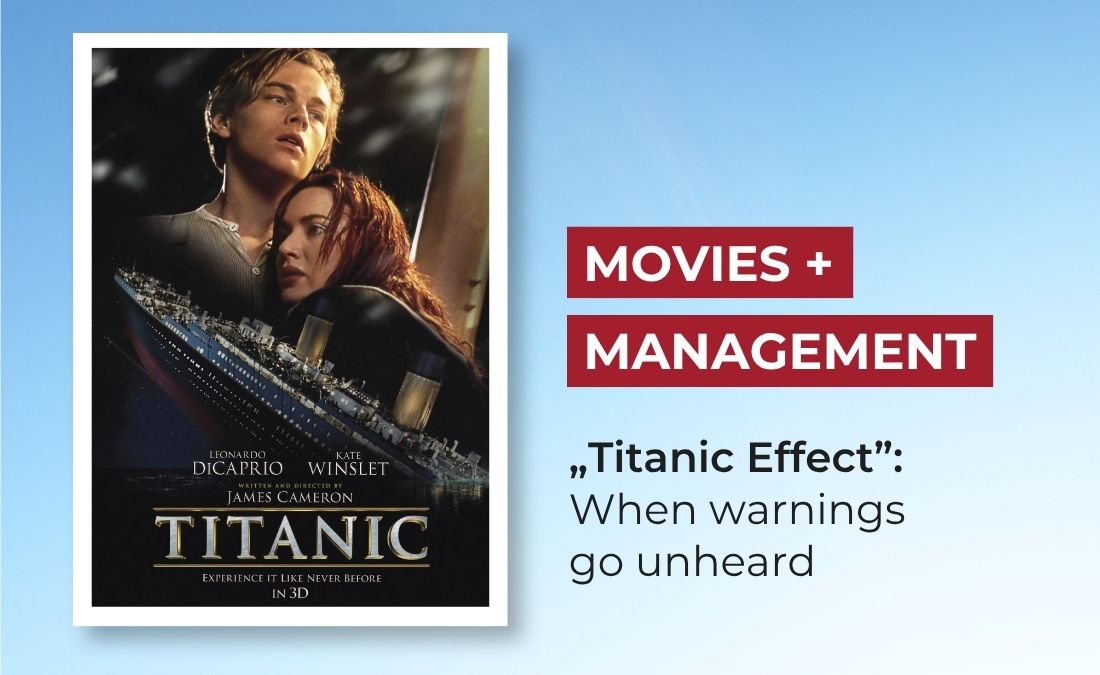
Movies + Management. Titanic Effekt: When warnings go unheard

Nobody wants to be the captain of the Titanic. And yet, project managers repeatedly fail to recognize real problems and steer straight towards the “iceberg.” Here are three warning signs and three rules to help keep projects on a safe course.

In the movie “Titanic,” James Cameron leaves no doubt as to who was at fault. What still leaves us stunned about this story today is the leadership’s mistaken belief that they had everything under control. Hours before the collision, the ship received several iceberg warnings. Nevertheless, the captain saw no reason to slow down.

The crew was so convinced of their usual approach: spotting icebergs in good time and steering clear of them. Yet on the night of the disaster, the sea was so calm that ice was barely visible in the surf. Added to this was the assurance from their own engineers that the Titanic was unsinkable.

Applied to projects, this means that those in charge overestimated the resources available and ignored mounting risks. In projects, the iceberg can be anything. For example, a system that has not been adequately tested. It could be a workstream that has been running behind schedule for months. Or there may be massive resistance from within the organisation.

Often, the people involved know there is a problem, yet they carry on as usual.


Three clear warning signs:

1. The deadline is set in stone

One of those statements that should set off alarm bells: “Our CEO has decided that we’re sticking to the go-live date.” And this despite the fact that those involved see the timing as being at risk.

This kind of thing happens because a major project often involves more than just the actual outcome. The deadline was communicated both internally and externally. A leader has made a commitment, and the project’s success is tied to that person’s reputation. The greater the personal and political commitment, the harder it becomes to evaluate new information with an open mind.

2. There is “no alternative” to the plan

One phrase we should be skeptical of in projects is “there is no alternative.” There are (almost) always alternatives. It’s just that they rarely come free of charge:

We can postpone a go-live. That could cost us money and damage our reputation.

We can reduce the scope. That diminishes the benefits.

We can allocate additional resources. That will cost money.

Given these alternatives, some believe it is wiser to stick to the original plan. But that, too, comes at a price. We just may not yet know how high it will be.

3. Sponsors are invisible

One of the clearest warning signs of all: No one in top management seems to want the project. Major transformations, in particular, require one or two strong C-level sponsors and a leadership team that actively supports the change.

It’s not enough for a board member’s name to appear on a slide. Sponsors must visibly demonstrate their interest, make decisions, and remove obstacles when the project runs into difficulties.

Three golden rules

Professional project management means recognizing problems early on. In that case, it makes more sense to hit the brakes in order to reach the goal at all.

If you want to manage projects safely, the following three rules are worth their weight in gold:

1. The steering committee as a helper, not a judge

If the project management team flags a “red light” to the steering committee and is penalized for doing so, we have a problem. As a result, there will be fewer red lights in the future. This means the steering committee will miss out on crucial information.

In well-run projects, there’s only one response to a yellow or red light: “What do you need from us so we can solve the problem?”

This is not a given and requires a culture in which those involved deal with problems and their own mistakes openly and constructively.

2. No escalation without alternatives

The project team also has a responsibility. Anyone who reports problems should also identify alternatives and make them transparent:

What are the implications of each alternative in terms of the delivery date, scope, quality, risks, and budget? Example: “We can postpone the go-live. That will cost us amount X. Or we can reduce the scope, with the consequence being Y. We can also stick to the deadline and accept risk Z in return.”

This way, management has the information it needs to make an informed decision about what price it is willing to pay.

3. An institution needs dissent

Sometimes those involved are too close to the situation to recognize problems. That is why it makes sense to bring in other perspectives. Before important decisions are made by the steering committee, for example, this can be done by using a “sounding board.”

People from different departments and levels of the organization provide feedback on decision-making documents:

  • Which assumption might be wrong?
  • Which perspective is missing?
  • Which risk are we downplaying?
  • What alternative have we not considered?
  • …

In important meetings, one person may also be given the mandate to play the devil’s advocate. For example, external parties who are not tied into internal hierarchies and are aware of warning signs from other projects are well-suited to the role of ‘court jester’.

The deeper lesson from “Titanic”

When we talk about project governance, we often discuss roles, committees, reporting cycles, and so on. But a culture that prioritizes saving face over substance will always penalise bad news. Competent people will then ignore warnings because they fear for their reputation.

In addition to the right structures, a healthy project organization needs a culture of self-criticism so that a warning is followed by a wise decision.

Sources on the historical events:

Documentation of the official investigation into the Titanic disaster:

Sir Ernest Shackleton’s witness account of sighting icebergs:

September 28, 2026, grosse-hornke

More articles