IT projects and change: Seeing isn't believing

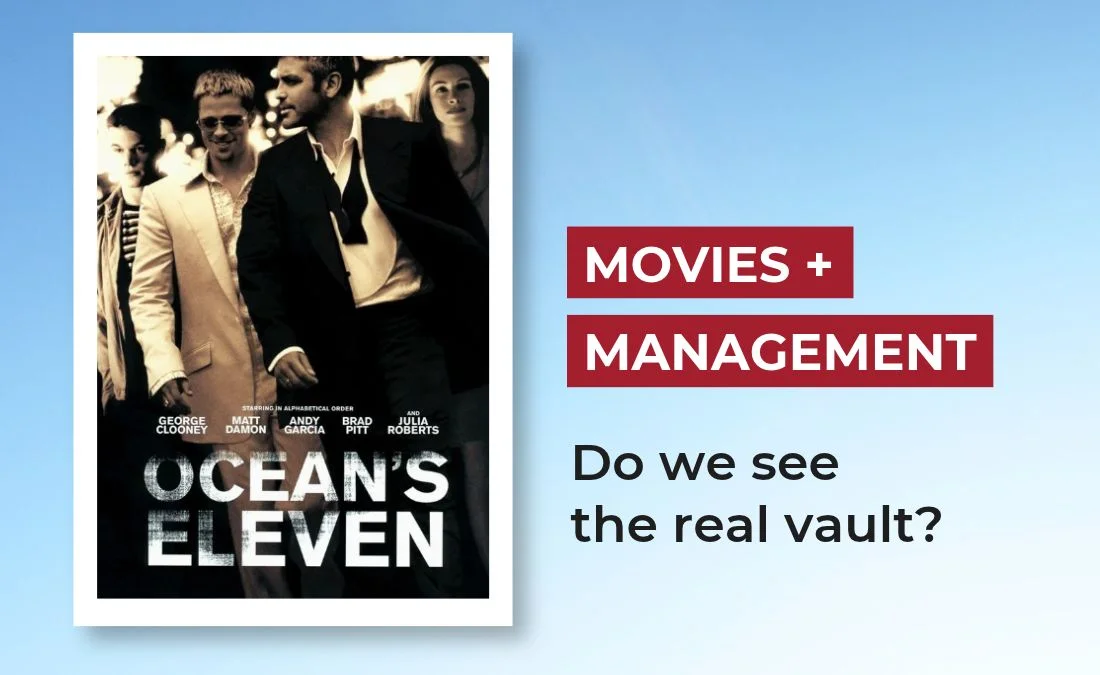
Movies and Management "Ocean's Eleven": Do we see the real vault?

Right before the SAP go-live, everything looks great: employees have been trained. But once the system is up and running, a lot of things don’t work the way they should. So what went wrong? Look closely, and “Ocean’s Eleven” has the answer.

Casino owner Terry Benedict leaves nothing to chance. His vault sits deep underground, protected by codes, cameras, laser grids, and armed guards. Terry feels completely safe, even from master thief Danny Ocean.

Until that one night. Terry is keeping an eye on his vault as usual, and everything seems quiet. But the video feed isn’t showing the real vault. It’s showing a replica. While Terry calmly watches the decoy, Danny cleans him out.

On the big screen, that’s entertaining. But look at it from another angle: in our own projects, we end up in Terry Benedict’s chair more often than we’d like to admit.

An SAP launch gone wrong

Take one of our clients. A few months ago, the company was preparing to roll out SAP. Heading into go-live, everything looked exemplary: training completion stood at 100 percent, and every user in logistics and production had attended. Then the system went live. And it quickly became clear that people didn’t really know what they were supposed to do.

Before long, production ran into trouble. Inventory data, for example, wasn’t up to date. Critical parts were missing. And that was just one of many things that weren’t running smoothly. For the organization, it meant stress, extra work, and unnecessary costs to head off shortages.

Knowing the fields isn’t enough

That’s when the company came to us. We looked at what had gone wrong. It turned out employees knew exactly which fields to complete in SAP. What they didn’t know was what happened before and after each step. For instance, which tasks still had to be done manually, and who needed which information at what point to keep things moving.

In short, the training had focused on the IT system, not on what the new process would look like from start to finish. As far as the leadership team was concerned, they had done everything right. But the green training light in the status report wasn’t a real signal. It was a decoy. It measured whether people had been trained, not whether they were actually ready.

What it really takes to go “green”

Preparing employees for a new process takes more than system training. Training is just one part of the change management every major IT transition needs. If leaders are going to make a confident go-live decision, the project team has to answer three questions:

  • Are we tracking the right metrics?
    The numbers need to show whether people can actually do their jobs on day one.

  • Have we rehearsed end to end?
    That means both manual and automated steps.

  • Who owns the interfaces?
    When everyone is responsible, no one is. Handoffs and dependencies have to be clear.

A dry run exposes the weak spots

In our experience, a process walkthrough is essential. We leave the training room and go where the work actually happens. There, we walk through the process with everyone involved, managers included. Someone in logistics scans in a delivery. What happens next? Where do the goods go, and who’s responsible for them? …

A dry run shows where the process doesn’t work the way it does on paper. That gives you the chance to course-correct before it counts. And so every department knows what to do after go-live, employees get a cheat sheet that explains each step.

Get out of the control room

In Ocean’s Eleven, it’s the thieves who rehearsed every step of their plan. Their opponent, Terry Benedict, trusts what he sees on the screen. All he’d have to do is go down to the vault once to see the truth.

The sooner you run this reality check, the better. Otherwise you’re putting blind faith in your monitoring, and later you’ll be the one explaining why go-live was anything but smooth.

2026-11-27, grosse-hornke

More articles